Boosting Biodiversity through Collaborative Agri-environmental Schemes

Kategorie: Dokument

  • Data on ecological network projects in Switzerland

    Data on ecological network projects in Switzerland

    By Lars Tschus, Franziska Zimmert, Petyo Bonev and Maximilian Meyer

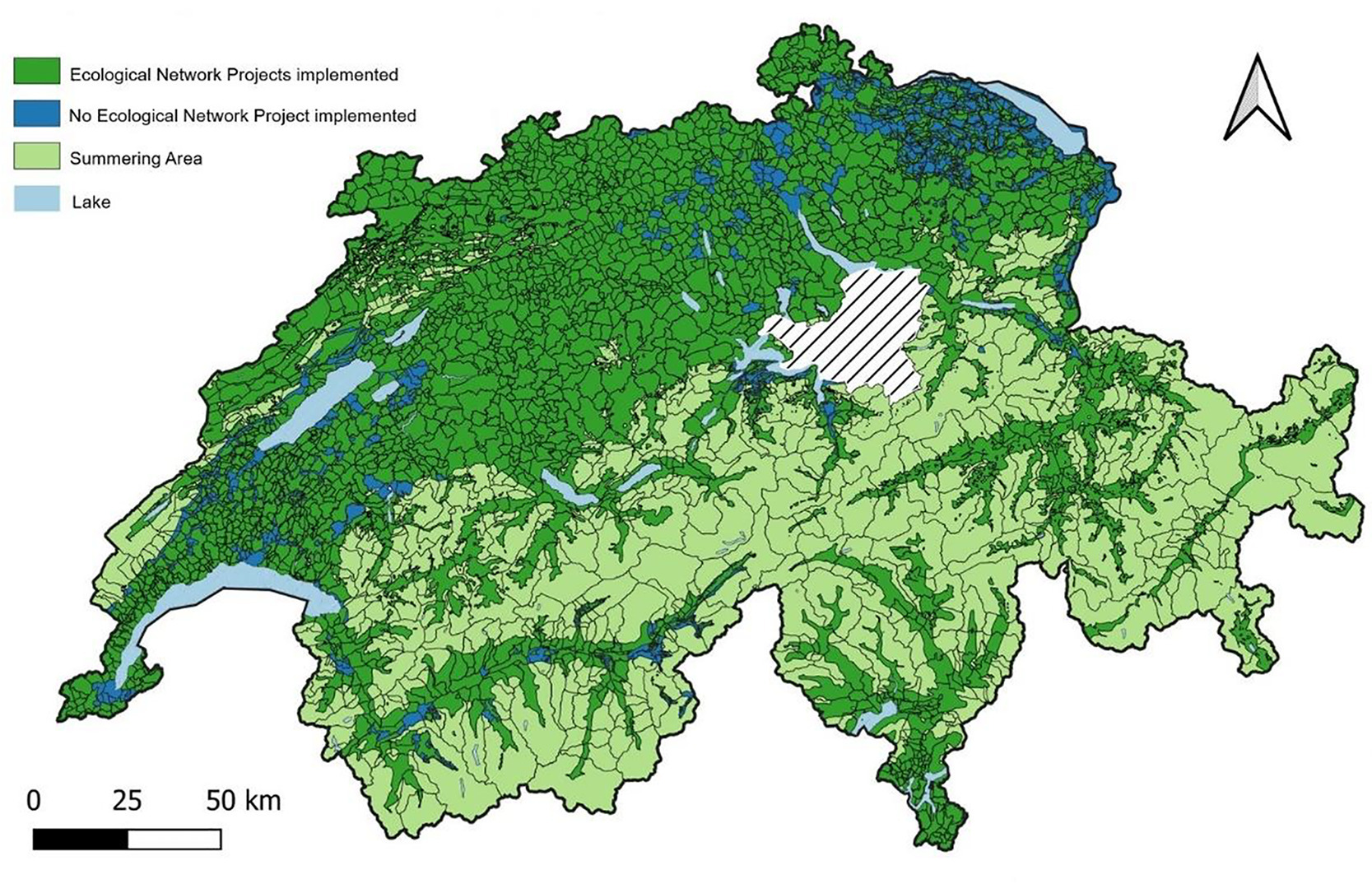
    Agriculture is one of the primary drivers of biodiversity loss. One agricultural policy instrument in this context is the spatial coordination of conservation efforts by farmers through ecological network projects, which provide spatially connected conservation areas, such as areas under agri-environmental schemes. However, the success factors for establishing ecological network projects, as well as their effects on various economic and ecological outcomes are still poorly understood. To obtain a deeper understanding of these important questions, we assembled a novel and comprehensive geospatial dataset of network project perimeters at the municipality level in Switzerland. Within these network project perimeters, farmers are eligible to enroll their agricultural plots that need to be managed according to the regulations of agri-environmental schemes. The dataset covers 98 % of Switzerland’s total land surface, including areas with and without ecological network projects. The dataset enables linkage with other data sources for future analyses, such as estimating the effect of network projects on e.g. the take-up of other agri-environmental schemes, farm income and biodiversity. To improve these future analyses, the dataset contains additional information such as the area and start year of an ecological network project, as well as the geographical share of ecological network projects in a municipality.

    Link to the Paper: Data on ecological network projects in Switzerland – ScienceDirect
  • Collaborative approaches at the landscape scale increase the benefits of agri-environmental measures for farmland biodiversity

    Collaborative approaches at the landscape scale increase the benefits of agri-environmental measures for farmland biodiversity

    By Eliane Meier, Gisela Lüscher, Felix Herzig, Eva Knopp

    Abstract

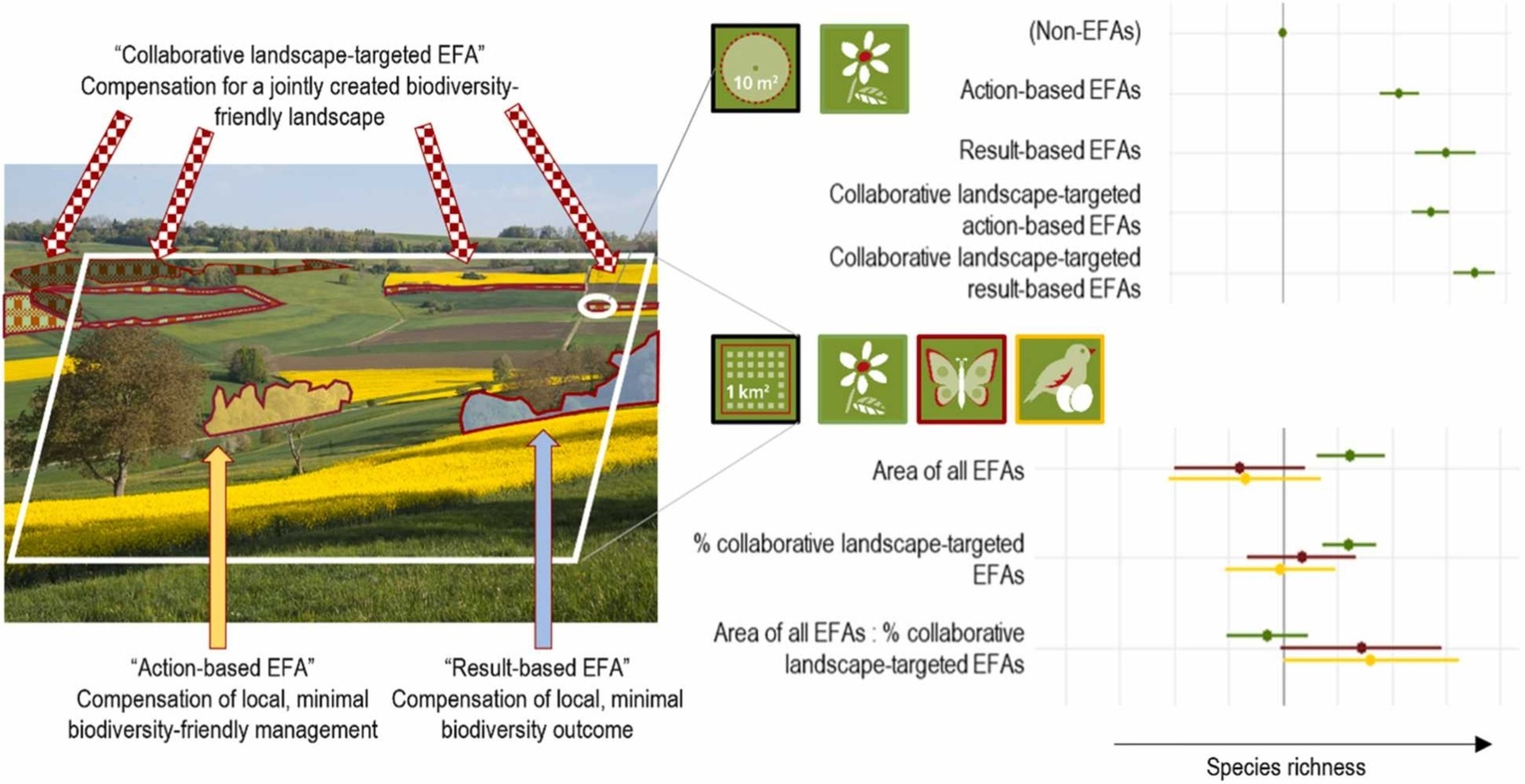
    Ecological focus areas (EFAs) are a key element of European agri-environmental measures, which aim at mitigating the negative impact of intensive agricultural practices on biodiversity. They are mostly implemented at local scale, such as action-based EFAs (prescribed minimum biodiversity-friendly management) and result-based EFAs (prescribed minimum biodiversity outcome). Implementation at the landscape scale as part of a collaborative landscape-targeted approach is less frequent. There, farmers of a given region jointly determine where and which measures are implemented in order to create a biodiversity-friendly landscape. The effectiveness of the three different, but often intertwined approaches to promote farmland biodiversity, has hardly ever been studied. To this end, we analyzed data from 121 1-km2 squares distributed across the Swiss agricultural landscapes. At local scale (10-m2 units), we found that plant species richness was higher in all EFA categories compared to management units outside EFAs, but tended to be highest in result-based and in collaborative landscape-targeted EFAs. At landscape scale (1-km2 units), plant species richness was positively related to a large total area of all EFAs, while butterfly and bird richness were positively related to a large total area of all EFAs with a high share of collaborative landscape-targeted EFAs. We conclude that while result-based, and especially collaborative landscape-targeted EFAs come along with higher transaction costs, they contribute substantially to farmland biodiversity at different spatial scales.

    Link to Paper: https://www.sciencedirect.com/science/article/pii/S0167880924000665